I adore plums. I like that they are small enough to rinse a handful at once, spinning them in your palm like Baoding balls. I love their range of shapes and colors that somehow match whatever you’re wearing. I love that each one hides a pit you can casually spit into the sink, and most of all I love that they grow on trees you can stand beneath, look up at, and feel that everything is right with the world. Even the word “plum” is pleasing to say, and the French prune has a soft, puckering sound that somehow fits the fruit.
One bright September day a few years ago almost spoiled my affection for plums: Maxence and I found a pick-your-own orchard in Alsace. We spent a blissful few hours filling buckets with mirabelles — tiny golden plums freckled with orange — and quetsches, the elongated, purple-blue plums that are sweeter than damsons. We snacked as we picked, wiping away the fine white bloom (the pruine in French) that signals true freshness; that powdery film disappears soon after a fruit is harvested, and its presence is a reassuring sign of tree-ripeness.
Since then, finding plums that match that memory has been a challenge. Local markets may offer crates of excellent fruit, but produce shops in big cities often sell plums picked a little early so they’ll survive transport. Anyone who loves fruit knows plums complete their ripening on the tree, not on a kitchen counter.
If you’re willing to be a little bold with your greengrocer and ask for a taste, you’ll avoid buying under-ripe fruit. If you’ve developed a friendly rapport with your produce seller, a smile often does the trick. Insist on tasting, and say politely, “Maybe not,” when the plum lacks sweetness. That way, only truly ripe, juicy plums ever make it home with you — and when you bring them back, you might celebrate by baking a tart.
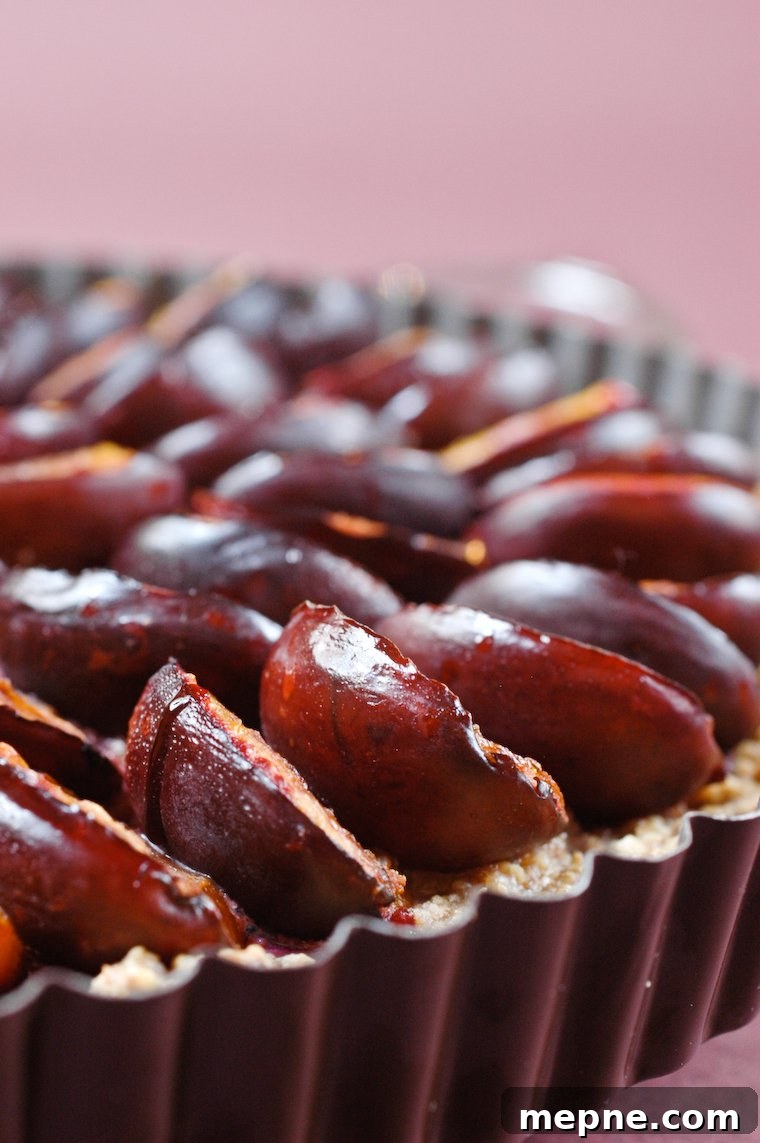
This recipe is a gentle variation on my mother’s classic tarte aux quetsches. Instead of pouring a custard of egg and cream over the fruit, the tart shell is lined with a walnut cream — crème de noix — made from ground walnuts, egg, sugar, and a little crème fraîche, the same filling used for walnut tarts in Périgord. I purposely use modest sugar in the walnut cream so a subtle, slightly bitter note can contrast with the sweet, sandy crust and the caramelized plums. Unrefined cane sugar adds a faint earthy depth that feels right for late summer and autumn baking.