When I go to the market, I carry a straw bag that Tommaso gave me for my birthday last year. It suits the mood perfectly: I feel as if I have stepped into a sunny food novel set somewhere in Provence, surrounded by stalls, colours, herbs, and familiar voices. It also gives me a practical limit. I can only buy what fits inside the bag, which is a useful rule when everything looks tempting.
I like to take my time at the market. I walk slowly, stopping by the producers and sellers who, over the years, have become friends. I buy fruit and vegetables, giving myself the pleasure of choosing wild chicory and herbs picked that morning, local apples, lemons with thick fragrant peel, and the first monk’s beard of the season.
Then I taste Gabriele’s new cheeses, choose the loaf with the most walnuts and raisins, and often give in to a few extra temptations: scamorza just arrived from Campania, salted bread, Burrata from Puglia, Roman ricotta, or spicy sausage.
But it is not always possible.
When I shop, I try to keep an eye on two essential family budgets: money and time.
I do my best not to waste food. I buy only what I believe we can use during the week, even though a new citrus fruit can still make me lose all discipline. I check best-before dates, think about a flexible weekly menu, and choose ingredients that can adapt to the recipes I will be cooking for work in the following days.
Time, however, is often the greatest obstacle, as I imagine it is for many families. The market can feel like a luxury. Most weeks, my shopping happens gradually between the supermarket and local shops. When I have enough time, I also add a visit to the weekly market or buy directly from producers.
There are a few stops I rarely give up, such as the butcher in my town, where I can find local meat: free-range chicken, organic Tuscan beef, and the local free-range pork known as Grigio della Montagnola. I also enjoy listening to the grandmothers in line before me, catching fragments of conversations about rumours, family meals, and recipes. I can ask for the best cuts for what I want to cook, but I can also trust the butcher and choose less familiar cuts. They may be less noble than fillets or ribs, but with patience and care they reward you with deep flavour and beautiful texture.
Some time ago, I bought a chicken. A whole organic, free-range chicken. If I had only been thinking about the grocery budget, it might have seemed excessive for two people. But when used well, a whole chicken can become the base for several meals.
How many meals can you get from a chicken?
I chose a very large pot, filled it two-thirds with water, and added a carrot, a celery stalk, a peeled onion studded with two cloves, a sprig of parsley, and a teaspoon of tomato paste. I also added the carcass of a roast chicken that I had frozen earlier. Just like boiled chicken, roast chicken still has something to offer even after all the meat has been eaten.
I brought the water to a boil, added a generous pinch of salt, and then lowered in the whole chicken. I reduced the heat and let it simmer, covered, for at least three hours. The smell of chicken broth is comforting in the same way as ragù: it warms you from the inside, settles into the house, and carries you back in time.
After three hours, the broth was golden and full of flavour. The chicken meat was juicy and tender enough to shred with a fork. On those last windy days of winter, a bowl of chicken broth with pasta and a generous spoonful of grated Parmigiano is the kind of comfort food that soothes the evening like a blanket. I had more broth than I needed, so I froze some in a bottle for a future risotto or soup.
Then, there is the meat.
I have a weakness for chicken salads, especially when the meat is tender and full of flavour. Using the meat from a whole chicken slowly cooked in broth is incomparably better than cooking only chicken breast. If a whole chicken feels like too much, or if you want to keep the recipe smaller and more affordable, use a chicken breast and a whole chicken leg. Simmer them slowly with herbs, carrot, celery, onion, and a teaspoon of tomato paste.
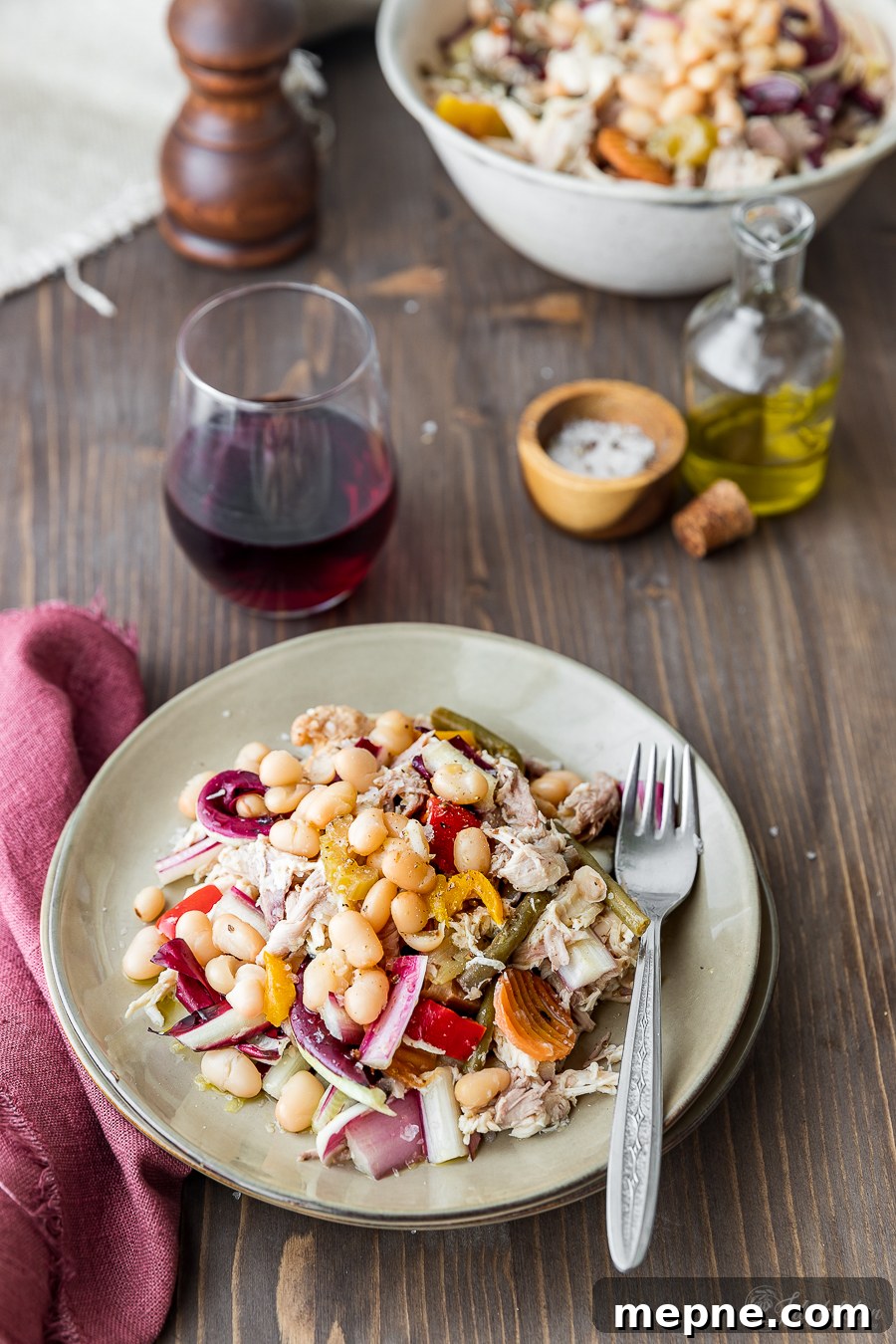
Cannellini bean and chicken salad, with pickles and radicchio
This cannellini bean and chicken salad sits between winter and spring. It has the comfort of beans and shredded chicken, balanced by the freshness of radicchio and pickled giardiniera. It reminds me of early spring days that are still cold, with a sharp wind and a clear sunny sky.
I served it as an appetiser with toasted bread for a family lunch. The slight vinegar note from the pickles wakes up the appetite. I also enjoyed it as a main course, adding extra radicchio because I love its clean, bitter flavour.
A few words about the ingredients
I used a local variety of beans, small and creamy, with a very thin skin. Cannellini beans are perfect here, but borlotti beans or your favourite cooked beans will also work.
The giardiniera I used was homemade. It is a mix of pickled vegetables preserved in olive oil, almost like a small vegetable garden in a jar. I usually choose the vegetables that best represent the season, blanch them briefly in water, vinegar, sugar, and salt, and then preserve them in extra virgin olive oil. Cleaning and cutting the vegetables takes the longest time; the cooking itself is short and gentle. If you do not have homemade giardiniera, choose a good-quality one, preferably preserved in olive oil rather than vinegar, otherwise the salad may become too sharp.
The radicchio tardivo gives the salad a fleshy texture and a pleasant bitterness. You can use your favourite radicchio, chicory, or endive. Choose a leafy vegetable with firm leaves and a clear bitter note, so it does not disappear among the stronger flavours.
And now, the recipe. Once you have boiled chicken and cooked cannellini beans ready, this Italian chicken salad is quick, simple, and satisfying.
Cannellini bean and chicken salad, with pickles and radicchio
Ingredients
- 550 g (1 ¼ lb) boiled chicken
- 200 g (½ lb) pickled giardiniera, well drained
- 250 g (½ lb) radicchio
- 150 g (¾ cup / 5 ¼ oz) cannellini beans, already cooked
- Extra virgin olive oil
- Salt
- Freshly ground black pepper
Instructions
-
Shred the cooked chicken with a fork. It is easier to do this while the meat is still warm from the broth, when it is soft and absorbs the seasoning more readily.
-
Transfer the shredded chicken to a bowl. Add the drained cannellini beans, the radicchio cut into strips, and the well-drained giardiniera.
-
Dress the salad with extra virgin olive oil, salt, and freshly ground black pepper. Stir gently so you do not crush the beans, then let the salad rest for about an hour before serving so the flavours can blend.
Serve the cannellini bean and chicken salad with…
Imagine a late winter day, when the wind is still cold but the sun is already warming the most sheltered corners. It may be too early for the full abundance of spring vegetables, yet you already crave clean, fresh flavours. This menu brings together the comfort of winter cooking and the first desire for spring. To finish the meal, a wholemeal crostata with lemon marmalade is a gentle reminder that it may be time to make a few jars of marmalade for the next tarts.
- Potato and artichoke soup. Artichokes are cooked with potatoes, leeks, and a little chicken broth. Serve the soup with sautéed artichokes and golden bread croutons, or with toasted hazelnuts and almonds if you prefer a gluten-free topping.
- Multigrain bread loaf. Serve the bean and chicken salad with slices of wholesome multigrain bread made with whole spelt flour, whole rye flour, and whole buckwheat flour, mixed with water and olive oil and baked into a crusty loaf.
- Lemon marmalade crostata. A crostata is simple to make and does not require special tools or advanced skills. Still, it can be fun to decorate it carefully, choose cutters, and ask for help lifting the pastry into the tin.
A final note
- We are trying to reduce plastic at home. We are only at the beginning, but we are learning to think more carefully about what we buy and use. One of the first changes was giving up coffee pods in favour of traditional coffee-making methods.
- Cooking with a whole chicken is another small way to be more mindful in the kitchen. It gives you broth, tender meat, and the foundation for several simple meals, including this cannellini bean and chicken salad with radicchio and pickled giardiniera.